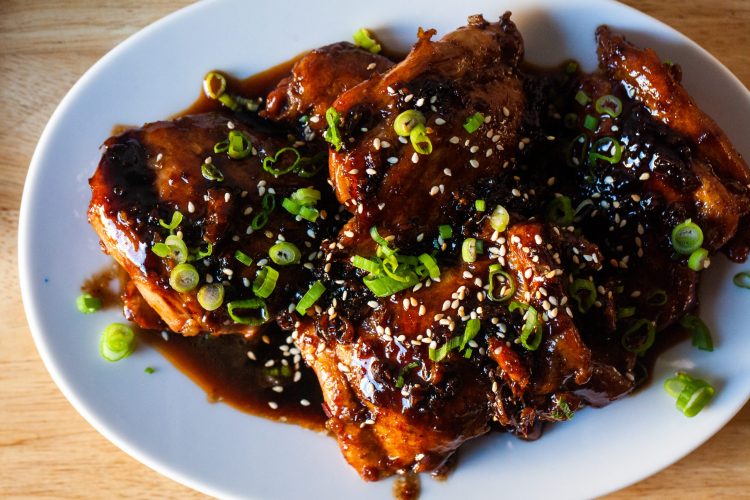
soy-glazed chicken
Instructions
It’s a gorgeous spring week in New York City, the windows are wide open, and before I find it impossible to resist the siren call of a full shift topicnic–summer-beach-fresh-everything mode (with some ice cream/pie/cookie breaks, naturally) I wanted to tell you about one last easy weeknight pandemic-era favorite: a soy sauce-basted chicken that my family would be happy if I made once a week forever.
I first made this in the early months, when all the restaurants were closed and we missed takeout*. I’ve made it almost monthly since then because it’s the fastest, easiest non-grilling way for me to turn a package of boneless, skinless chicken thighs or breasts into a meal that everyone actually finishes. Browning the chicken well gives it a slightly crisp edge, and reducing a mixture of garlic, ginger, soy sauce, rice vinegar, and brown sugar around it while the chicken finishes cooking gives it a lacquered effect.
I turn it into dinner by making plain white or brown rice in the rice cooker**. If we have any broccoli, I’ll steam or roast it. And then I make a quick salad with a thinly sliced or julienned fresh vegetable, whatever we’ve got that’s crunchy, such as cucumbers, carrots, cabbage, asparagus, or in this week’s case, snow peas and sugar snaps. A soak in ice water really perks up snow peas, sugar snaps, and carrots if yours have also gotten neglected in the produce drawer. Toss with thinly-sliced scallion, salt, pepper, white rice vinegar and toasted sesame oil to taste and that’s it, a triumphant weeknight meal that I hope makes it into your rotation too.
*Origin note:Although I started making this in a pandemic pinch with leftover dipping sauce I use for dumplings, this style of chicken is a distant relative to the Cantonese dish calledsee yao gaior soy sauce chicken. Usually it’s a whole chicken braised in soy sauce with star anise, bay leaves, and Shaoxing rice wine in addition to the ingredients below, then chopped and served with vegetables and rice or noodles. It’s amazing, and a quintessential Chinatown favorite/stapleworth seeking out.
** I’ve hadthis onefor eight years and it was worth every penny, and not only because it plays twinkle-twinkle when it starts
Ingredients
Vegetable oilKosher salt and freshly ground black pepper1 1/2 pounds boneless skinless chicken thighs or breast cutlets1 tablespoon minced garlic1 tablespoon minced fresh ginger3 tablespoons tamari, or light or low-sodium soy sauce4 tablespoons unseasoned rice vinegar or 2 tablespoons black vinegar and 2 tablespoons rice (see Note)2 tablespoons brown sugar (I use dark)Toasted sesame seeds and/or a thinly-sliced scallion to finish
Cooking Tips
If using chicken breast cutlets, I often pound or slice them thinner so that they cook faster. I really love using a mixture of (unseasoned) rice vinegar and black vinegar (here are good explainers onbothkinds) but use whatever you have. The glaze will be lighter in color with only rice vinegar. To ensure this dish is gluten-free for anyone who needs it to be, check that your tamari or soy sauce is labeled as such.